Viking Range Hood Has Weak Airflow: Filters, Ducting, or Blower?
Weak capture can come from grease-loaded filters, blocked intake areas, duct resistance, a stuck exterior damper, insufficient make-up air, blower hardware, or controls. A…
A Viking wine cellar can drift because of door sealing, loading, room conditions, ventilation, fans, sensors, controls, or the refrigeration system. One display reading is not enough to identify the failed system.

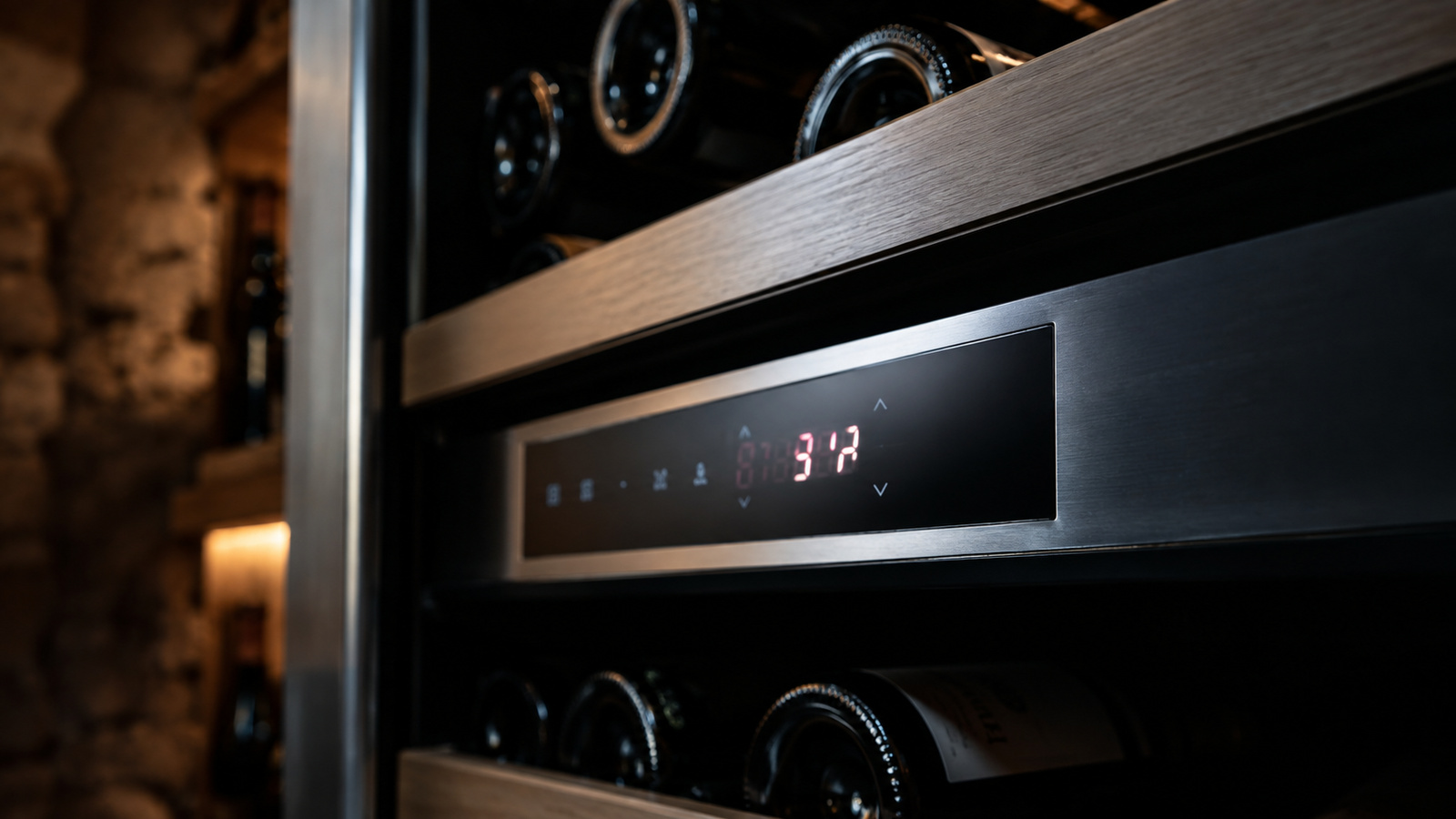
A Viking wine cellar that is not cooling has often been affected by where it sits and how it is used: warm surroundings, a blocked front grille, frequent door openings or a gasket that is not sealing. Watch the temperature trend for a full day after any change, and book a diagnosis if the cabinet keeps drifting.
A Viking wine cellar can drift because of door sealing, loading, room conditions, ventilation, fans, sensors, controls, or the refrigeration system. One display reading is not enough to identify the failed system.
Change one condition at a time. Resetting power, changing settings, cleaning multiple systems and moving the appliance all at once can erase evidence.
| Symptom | What it can point to | What you can safely check |
|---|---|---|
| Warm right after loading bottles or opening the door repeatedly | Contents have not stabilized; the manual points to excess door opening and a 24-hour settling period | Leave the door closed and compare readings the next day |
| Cellar sits in a hot space | The room is outside the 55 to 100F installation range | Measure the room temperature |
| Grille area is covered or customized | Blocked airflow; the bottom front ventilation must stay clear and a custom grille is not recommended | Clear anything near the bottom front |
| Door does not close fully | A bad seal or a bottle touching the door | Check that bottles do not hold the door open |
| Control looks too warm | The setting itself | Confirm the setpoint |
| Noise or vibration | The cabinet is not level, or a fan is hitting an obstruction | Check that it is level and nothing sits near the fan |
Viking wine-storage products should be evaluated as temperature trends. Door openings, bottle loading, room conditions, ventilation, fans, sensing, controls and refrigeration all affect recovery.
The manual for the undercounter wine cellar gives an installation location range of 55 to 100F and says the ventilation at the bottom front must stay clear. A cellar tucked into tight cabinetry with a custom grille can restrict the air it uses, which looks like poor cooling even if the sealed system is fine.
The manual’s not-cold-enough list covers a control set too warm, contents that have not stabilized, excess door opening, blocked grille airflow and a bad gasket. All of them can be observed from outside the cabinet.
A symptom identifies a system to investigate; it does not identify one replacement part. Installation, utilities, sensors, wiring, airflow, mechanical components, controls and the appliance’s heating or refrigeration system can create similar outward behavior.
If the cabinet repeatedly drifts and cannot recover after normal use, fans, sensing, controls, or the refrigeration system may need model-aware diagnosis.
Viking’s FAQ notes that a well-stocked cellar holds its temperature better because the compressor cycles less. A nearly empty cabinet may swing more after each door opening, and a freshly stocked one needs time before the display reflects the real bottle temperature.
If drift continues after a day of undisturbed running with the grille clear and the room within range, the pattern points to fans, sensing or the refrigeration system rather than to how the cellar is used.
Write down:
Those details reduce repeated owner checks and help the technician choose a focused diagnostic path.
Leave heavy professional ranges, built-in refrigerators, wall ovens, undercounter products and tightly installed appliances in place unless the service team specifically requests access. Moving an appliance without a plan can disturb flooring, cabinetry, anti-tip hardware, gas, electrical, water, drain or ventilation connections.
For condos, high-rises, gated properties and custom kitchens, include loading, elevator, shutoff, parking and clearance information when booking.
Do not clear a useful code before recording it. Do not order a part because another Viking owner described a similar symptom. Do not apply an oven F-code meaning to a refrigeration or dishwasher platform without verification.
One controlled owner-level check is useful when it answers a question. Repeated resets and panel removal usually remove evidence instead of adding it.
For adjacent symptoms, read Viking Refrigerator Not Cooling: Separate Door, Airflow, and Refrigeration Clues and Viking Refrigerator Repair Cost: What Actually Changes the Estimate.
Should I keep resetting the Viking appliance if it starts working again? Use one normal model-approved restart when appropriate and record any code first. If the same condition returns, repeated resets are not a repair.
Should I buy a part from the symptom or F-code alone? Usually no. Similar symptoms can come from different components, installation conditions or utility problems.
Can I remove panels to inspect wiring, gas parts or controls? No. Keep homeowner checks external and model-appropriate.
Why does the full model number matter? Viking has multiple product series and generations. Exact model identity helps prevent the wrong technical path.
How long should I wait before deciding a Viking wine cellar is not cooling? The manual lists contents that have not stabilized among the causes and mentions 24 hours. Avoid opening the door during that time, then compare readings.
Can a custom grille affect cooling? The manual says a custom grille is not recommended and that the bottom front ventilation must stay clear. Restricted airflow is one of its listed reasons for a cellar that is not cold enough.
Does an empty cellar hold temperature as well as a full one? A well-stocked cellar holds temperature better, according to Viking’s FAQ, because the compressor cycles less.
Weak capture can come from grease-loaded filters, blocked intake areas, duct resistance, a stuck exterior damper, insufficient make-up air, blower hardware, or controls. A…
A Viking burner that keeps clicking can be reacting to moisture, a mis-seated cap, debris around the igniter, a switch condition, wiring, or ignition…
Standing water after a Viking dishwasher cycle can come from the filter/sump, drain hose, sink or disposer connection, check path, pump, sensing, or controls.…
Share a few details and we’ll confirm an appointment. Prefer to talk? Call us and we’ll help right away.