Viking Range Hood Has Weak Airflow: Filters, Ducting, or Blower?
Weak capture can come from grease-loaded filters, blocked intake areas, duct resistance, a stuck exterior damper, insufficient make-up air, blower hardware, or controls. A…
A Viking refrigerator that is warming can have a sealing, airflow, fan, sensor, defrost, control, compressor, or sealed-system problem. The useful first step is to compare actual compartment temperatures and recovery…

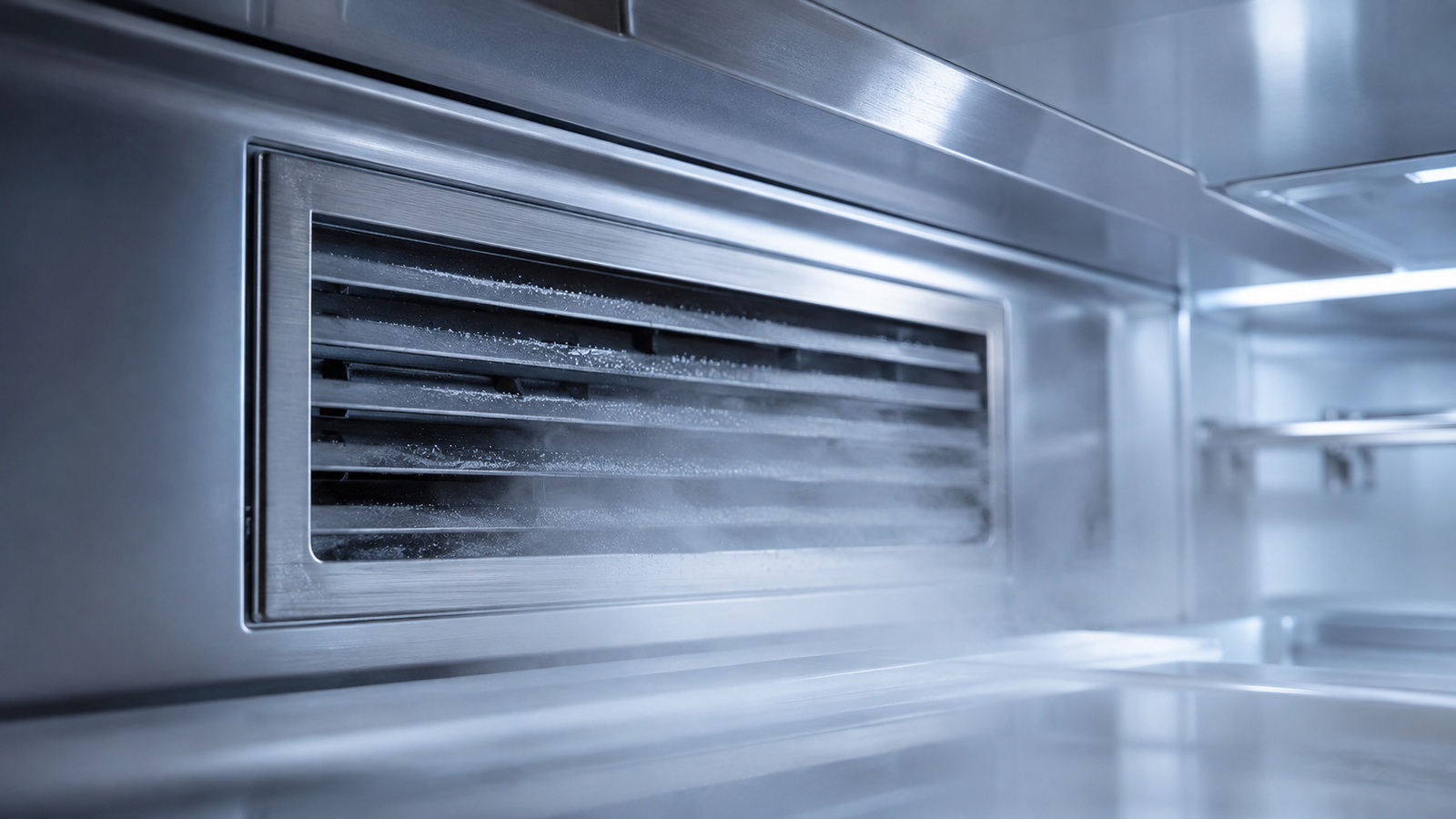
When a Viking refrigerator is not cooling, start with what can be seen: doors that close fully, gaskets free of debris, shelves that do not block air paths, and separate readings for the fresh-food and freezer sections. Those checks sort out door, airflow and loading causes, and temperatures that keep rising after them call for model-aware diagnosis.
A Viking refrigerator that is warming can have a sealing, airflow, fan, sensor, defrost, control, compressor, or sealed-system problem. The useful first step is to compare actual compartment temperatures and recovery behavior rather than guessing from one warm shelf.
Change one condition at a time. Resetting power, changing settings, cleaning multiple systems and moving the appliance all at once can erase evidence.
| Symptom | What it can point to | What you can safely check |
|---|---|---|
| Food near the top shelf freezes while other areas stay warm | Overcrowding blocks air movement, and food under the air vent on the uppermost shelf may freeze | Rearrange so nothing blocks the vents |
| Open-door alarm | The door was left open for 3 minutes or is not closing fully | Check for packages against the seal |
| Gasket looks stiff or dirty | A seal that is not pliable or clean | Clean it; the manual suggests every three months, with a light film of petroleum jelly to keep it pliable |
| Flashing CL | A condenser-coil cleaning reminder on a 7 Series integrated model | Vacuum the front of the coil as described |
| Display off the set point after plug-in or hot food | Stabilization | Wait 24 hours before adjusting |
| Compressor runs a long time | Described as normal with hot days, large loads and frequent door opening | Reduce door openings and watch the trend |
Viking refrigeration spans built-in, integrated, freestanding, undercounter and related ice/water systems. Exact model identity, cabinet ventilation, door alignment and refrigeration platform matter before technical information is applied.
A cabinet can only hold temperature if cold air moves where it is meant to and the seal stays closed. The manual warns that an overcrowded cabinet blocks air movement, so a full week of groceries can look like a cooling fault. It also notes that foods on the uppermost shelf under the air vent may freeze.
Gasket condition is just as simple to inspect. Wipe it, check that nothing holds the door open, and see whether the warm area follows the door side.
A symptom identifies a system to investigate; it does not identify one replacement part. Installation, utilities, sensors, wiring, airflow, mechanical components, controls and the appliance’s heating or refrigeration system can create similar outward behavior.
If temperatures continue to rise after normal door, loading, airflow, and setting checks, model-aware testing may need to separate fans, sensors, defrost, controls, compressor operation, and the sealed system.
The 7 Series bottom-mount refrigerator calls for vacuuming the front of the condenser coil about every 6 months, and a blinking CL prompts it. The 5 Series built-in uses a pin-and-tube condenser that the manual describes as maintenance-free under normal operation, so a cleaning reminder does not apply to every Viking model.
The manual lists 38F for the refrigerator and 0F for the freezer as the starting settings and asks for a 24-hour wait before any adjustment. Changing settings repeatedly during that period makes it hard to tell recovery from a lasting problem.
Write down:
Those details reduce repeated owner checks and help the technician choose a focused diagnostic path.
Leave heavy professional ranges, built-in refrigerators, wall ovens, undercounter products and tightly installed appliances in place unless the service team specifically requests access. Moving an appliance without a plan can disturb flooring, cabinetry, anti-tip hardware, gas, electrical, water, drain or ventilation connections.
For condos, high-rises, gated properties and custom kitchens, include loading, elevator, shutoff, parking and clearance information when booking.
Do not clear a useful code before recording it. Do not order a part because another Viking owner described a similar symptom. Do not apply an oven F-code meaning to a refrigeration or dishwasher platform without verification.
One controlled owner-level check is useful when it answers a question. Repeated resets and panel removal usually remove evidence instead of adding it.
For adjacent symptoms, read Viking Wine Cellar Not Cooling: Temperature Drift Has More Than One Cause and Viking Refrigerator Repair Cost: What Actually Changes the Estimate.
Should I keep resetting the Viking appliance if it starts working again? Use one normal model-approved restart when appropriate and record any code first. If the same condition returns, repeated resets are not a repair.
Should I buy a part from the symptom or F-code alone? Usually no. Similar symptoms can come from different components, installation conditions or utility problems.
Can I remove panels to inspect wiring, gas parts or controls? No. Keep homeowner checks external and model-appropriate.
Why does the full model number matter? Viking has multiple product series and generations. Exact model identity helps prevent the wrong technical path.
How long before a new Viking refrigerator reaches temperature? The 7 Series manual says to wait 24 hours before adjusting the factory settings of 38F in the refrigerator and 0F in the freezer.
How often should the door gaskets be cleaned? The manual suggests every three months, with a light film of petroleum jelly to keep them pliable.
Can an overloaded refrigerator cause warm spots? Yes. Overcrowding blocks air movement, and the manual says foods on the uppermost shelf under the air vent may freeze.
Weak capture can come from grease-loaded filters, blocked intake areas, duct resistance, a stuck exterior damper, insufficient make-up air, blower hardware, or controls. A…
A Viking wine cellar can drift because of door sealing, loading, room conditions, ventilation, fans, sensors, controls, or the refrigeration system. One display reading…
A Viking burner that keeps clicking can be reacting to moisture, a mis-seated cap, debris around the igniter, a switch condition, wiring, or ignition…
Share a few details and we’ll confirm an appointment. Prefer to talk? Call us and we’ll help right away.