On Viking dishwashers, filter and wash-arm cleaning is the main way to keep debris from becoming a poor wash, an odor, or standing water. Clean the filter assembly and check the spray arm holes weekly, never run the machine without the filter, and treat leftover water as a drain problem only after the filters are clean.
Food debris in owner-accessible filter and sump areas can reduce wash performance, contribute to odor, and complicate draining. Routine cleaning gives circulation and drain systems a clean baseline.
A Practical Maintenance Routine
- Clean user-serviceable filter/sump components on the model-appropriate schedule.
- Check that spray arms can rotate freely after loading.
- Use detergent and rinse-aid settings appropriate to the selected cycle and water conditions.
| Symptom |
What it can point to |
What you can safely check |
| Water left in the tub |
Clogged filters, or a blocked discharge hose |
Clean the filters; check the hose for a kink |
| Odor |
Clogged filters or dirty dishes left in the machine |
Clean the filters and clear food remnants |
| Poor wash results |
Filter placed incorrectly, or clogged spray arm holes |
Reseat the filter; check the arm holes |
| E:01 flashing |
Too much water or leak detected |
Stop and follow the leak guidance |
Viking-Specific Context
Viking dishwashers are built-in systems where loading, filtration, household water/drain conditions, circulation, heating, sensing and controls all affect the cycle. The cycle stage is useful evidence.
Maintenance should preserve normal sealing, airflow, water flow, drainage, loading, filtration, ventilation and user-accessible cleanliness.
How is the Viking dishwasher filter built?
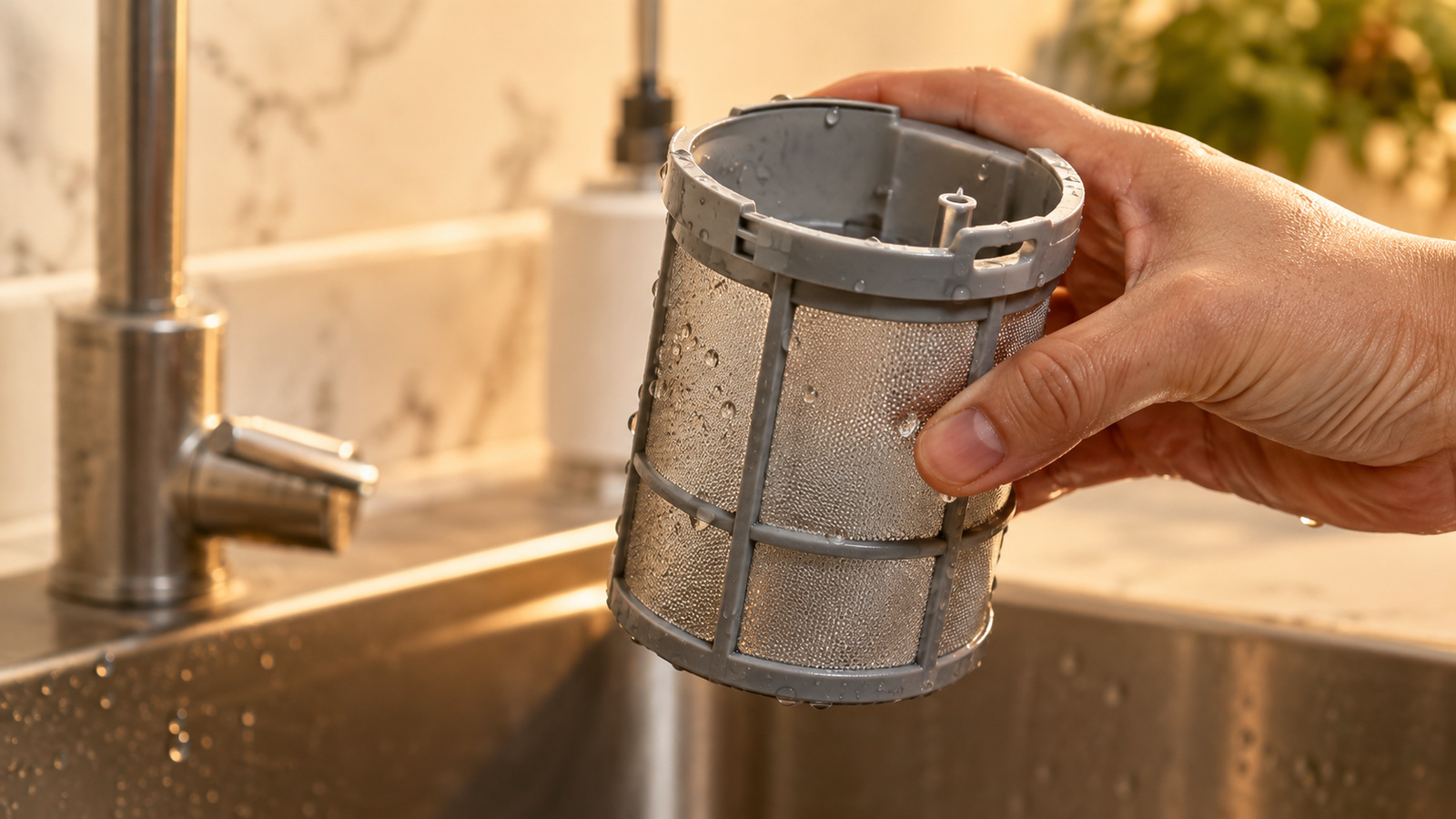
The manual for the Viking 3 and 5 Series dishwashers says to clean the filters at least once a week. Turn the micro-filter and coarse-filter assembly counterclockwise and pull up, remove the metal or plastic filter, and separate the coarse filter by pressing its two tabs. Clean all three pieces under tap water with a brush, then reassemble until the coarse filter clicks. The underside of the main filter has a sharp outer edge that can cut, so handle it carefully.
Why can’t a Viking dishwasher run without its filter?
The manual states that the dishwasher should not be used without the filter, and that incorrect filter placement reduces washing efficiency. A filter that looks seated but is slightly off can produce the same poor results as a dirty one.
When Maintenance Has Reached Its Limit
If washing, draining, or drying remains poor after correct care, routine maintenance has reached its limit.
If the same symptom returns after correct routine care, move to diagnosis rather than stronger chemicals, repeated resets or random parts.
How do spray arms relate to odor and standing water?
Clean the wash arms at least once a week and check the lower and upper arm holes for clogging. For odor, the manual lists clogged filters and dirty dishes left for 2 to 3 days. Remove remnants, run Rinse and Hold without detergent every 2 days, and leave the door ajar. A new machine can also have a peculiar odor that fades after a few washes.
When water remains at the end of a program, the listed causes are clogged filters and a blocked or clogged discharge hose. Cleaning the filter first rules out the simplest explanation before a drain diagnosis.
What to Record Before Service
Write down:
- the complete Viking model number;
- the appliance family and installation style;
- the exact symptom in one sentence;
- when it began;
- whether it is constant or intermittent;
- what related function still works normally;
- any displayed F-code, message, alarm or light pattern before reset;
- any recent power, gas, water, drain, ventilation, cleaning, filter or installation event.
Those details reduce repeated owner checks and help the technician choose a focused diagnostic path.
Models and Error-Code Context
The E:01 message in the dishwasher manual refers to too much water or a leak, not to a clogged filter, and it clears if the overflow stops. If it stays on, the manual describes a permanent fault that needs service.
Installation and Access Context
Leave heavy professional ranges, built-in refrigerators, wall ovens, undercounter products and tightly installed appliances in place unless the service team specifically requests access. Moving an appliance without a plan can disturb flooring, cabinetry, anti-tip hardware, gas, electrical, water, drain or ventilation connections.
For condos, high-rises, gated properties and custom kitchens, include loading, elevator, shutoff, parking and clearance information when booking.
Common Mistakes to Avoid
Do not clear a useful code before recording it. Do not order a part because another Viking owner described a similar symptom. Do not apply an oven F-code meaning to a refrigeration or dishwasher platform without verification.
One controlled owner-level check is useful when it answers a question. Repeated resets and panel removal usually remove evidence instead of adding it.
For adjacent symptoms, read Viking Dishwasher Not Draining: Standing Water Has a Sequence and Viking Dishwasher Repair Cost: Drain, Leak, Wash, Heat, or Controls?.
Similar Articles
- Viking Services
- Viking Appliances
- Viking Models
- Viking Error Codes
- Contact / Book a Repair
FAQ
Should I keep resetting the Viking appliance if it starts working again? Use one normal model-approved restart when appropriate and record any code first. If the same condition returns, repeated resets are not a repair.
Should I buy a part from the symptom or F-code alone? Usually no. Similar symptoms can come from different components, installation conditions or utility problems.
Can I remove panels to inspect wiring, gas parts or controls? No. Keep homeowner checks external and model-appropriate.
Why does the full model number matter? Viking has multiple product series and generations. Exact model identity helps prevent the wrong technical path.
What is the cleaning interval for the filter and spray arms? The manual says at least once a week. It also says the wash arms should be cleaned at least once a week and their holes checked for clogging.
Can I run the dishwasher without the filter? No. The manual says not to use the machine without the filter, and warns that incorrect placement reduces washing efficiency.
Why does my dishwasher smell? The manual lists clogged filters and dirty dishes left for 2 to 3 days. Clean the filters, remove food remnants, and use the manual’s Rinse and Hold steps; a new machine’s odor fades after a few washes.